Reading a timber cruise report: what the numbers mean for your woodlot
Your forester hands you a stapled report, maybe eight or twelve pages, and somewhere on page two is a table full of numbers you didn't expect to need a glossary for. That feeling is common among landowners across Windham County, from the sugar maple ridges above Newfane to the mixed hardwood-softwood lots tucked into the hills around Halifax. A timber cruise report is genuinely useful - but only once you can read it. This guide walks through every major section, explains the logic behind each measurement, and helps you connect the numbers to real decisions about your land.
What a timber cruise actually is
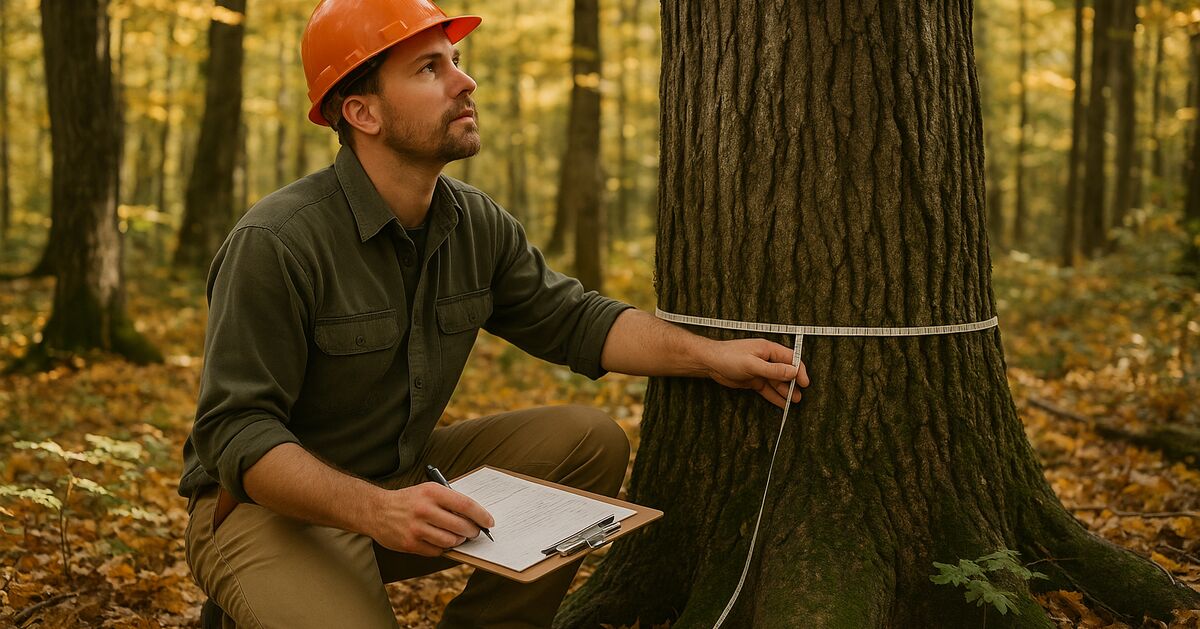
A timber cruise is a systematic field inventory of the trees standing on your property. A forester walks a series of sample plots - spaced at regular intervals across the parcel - and records the species, diameter, and condition of every tree that qualifies under the cruise design. The plots are statistically distributed so that the sample represents the whole stand without measuring every single stem.
The word "cruise" comes from old surveying language for traveling a course through the woods. The forester is not just walking around; they are following a grid, using a prism or angle gauge to select which trees to tally, and recording data that will be projected up to a per-acre figure and then multiplied across your total acreage.
The accuracy of a cruise depends on plot size, plot spacing, and the care of the cruiser. A well-designed cruise on a 50-acre lot in Grafton or Athens might use 15 to 25 sample plots. Too few plots on variable terrain, and the margin of error grows large enough to make the volume estimates unreliable.
Basal area: the foundation of the whole report
The number that shows up first - and one foresters commonly reference - is basal area, expressed in square feet per acre (sq ft/ac). Basal area is the cross-sectional area of all tree stems at breast height (4.5 feet off the ground), added together and expressed on a per-acre basis.
Here is why it matters: basal area is a proxy for how crowded your stand is. A stand with 180 sq ft/ac of basal area is dense. Trees are competing hard for light, water, and nutrients. Diameter growth slows down. A stand with 60 sq ft/ac is open. Trees have room to grow, the forest floor gets more light, and browse plants that deer and turkey depend on have space to establish.
The Vermont Department of Forests, Parks and Recreation uses basal area thresholds when reviewing forest management plans for the Current Use program. Different species groups have different target ranges, but as a general reference point, many well-managed northern hardwood stands aim to maintain residual basal area in the range of 60 to 90 sq ft/ac after a harvest. Your forester will set the specific target based on your stand's composition and your management goals.
When you see the basal area table in your cruise report, look at it by species. A lot in Townshend might show 140 sq ft/ac total, but if 80 of those square feet belong to beech affected by beech bark disease, the commercially useful basal area is much lower than the headline figure suggests.
Board feet and cords: measuring what can be sold
Below the basal area summary, most cruise reports show volume estimates, typically in two units:
- Board feet (MBF) - used for sawtimber, the larger-diameter trees whose trunks can be milled into lumber. MBF means thousand board feet. A single mature sugar maple might scale to 150-250 board feet depending on its form and height.
- Cords - used for pulpwood and biomass, which are smaller-diameter stems or tops and defective material that cannot make grade as sawtimber.
The report will usually separate these by species and by product class - sawtimber versus pulpwood. Pay attention to that split. A stand that looks impressive by total volume might be 70% pulpwood, which commands a much lower stumpage price than sawtimber. Conversely, a stand with a modest total volume but a high proportion of high-quality sugar maple or yellow birch sawtimber can represent real value.
The log rule used to calculate board feet also matters. Vermont foresters commonly use the Doyle log rule or the International 1/4-inch log rule. Doyle and International log rules calculate volume differently, and results can vary noticeably depending on log size, so it's worth confirming which rule was used before comparing two reports. If you are comparing two cruise reports, make sure they used the same log rule, or the volumes are not directly comparable.
The species table: reading your forest's composition
A well-formatted cruise report will include a species breakdown - how many stems per acre, how many square feet of basal area per acre, and how much volume belong to each species. This table tells you what kind of forest you actually have, which may differ from what it looks like on a walk-through.
Common species you might see on a Windham County woodlot include:
- Sugar maple - the backbone of a high-value northern hardwood stand; look for good form and no significant crown dieback
- Yellow birch - a premium species for flooring and cabinetry; typically found on cooler north slopes and moist draws
- Red maple - widespread and commercially useful, though usually at lower stumpage than sugar maple or yellow birch
- Eastern hemlock - important for thermal cover and stream bank stability; markets exist but have been affected by the spread of hemlock woolly adelgid moving north
- White ash - once abundant throughout the county; emerald ash borer has fundamentally changed how foresters approach ash in any plan
- American beech - present on almost every lot in this region; beech bark disease means a large portion of beech stems have compromised long-term prospects
The species table also helps your forester explain stocking - whether your forest has the right mix of species in the right size classes to remain productive over the next rotation. A forest dominated by a single age class of one species is more vulnerable to market swings, disease, and weather events than a diverse, uneven-aged stand.
Diameter distribution: the story your forest is telling
One of the most informative sections of a timber cruise report is the diameter class distribution, sometimes shown as a bar chart or frequency table. Diameter classes are usually grouped in two-inch increments: 6-7 inches, 8-9 inches, 10-11 inches, and so on up to 20+ inches.
A healthy uneven-aged forest - the kind encouraged by selection silviculture - shows a classic reverse-J or descending curve: many small stems, fewer medium stems, and a small number of large stems. This shape means the stand is regenerating itself continuously and has trees at all stages of development.
A forest that was heavily cut 30 or 40 years ago and left alone often shows a hump in the mid-diameter classes (say 10 to 14 inches) with relatively few large trees and sometimes sparse regeneration in the small classes. This tells a forester that the stand went through an even-aged release event and has been growing toward maturity in a relatively uniform cohort. That is not necessarily bad, but it shapes what kind of harvest makes sense now.
When lots in Marlboro or Windham show a hollowed-out diameter distribution - plenty of small stems and a few large old trees, but almost nothing in the middle - it often signals past high-grading, where only the best trees were removed and the poorer-quality stems were left to seed the next generation. Understanding this history is essential before any new harvest decision is made.
Quality grades and defect notation
Volume alone does not determine value. A cruise report from a careful forester will include some notation about log quality or grade. This might be expressed as a percentage of sawtimber volume that grades as No. 1 or better versus No. 2 or No. 3, or it might be captured in a defect column that notes sweep, rot, fork, or seam for individual trees.
Defect matters enormously at the mill. A sugar maple log with a frost crack running its length may scale to 200 board feet on paper, but the mill will deduct heavily for defect - or reject it entirely. When a cruise report flags high defect percentages in a species, that is a signal to temper the volume numbers with realistic expectations about what a logger will actually bid on.
What the report does NOT tell you
A timber cruise is a snapshot of volume and stocking. It does not, by itself, tell you:
- What the timber is worth in today's market - stumpage prices fluctuate with lumber demand, mill capacity, logging costs, and access. A forester with current market knowledge needs to interpret the volume estimates in the context of current prices.
- Whether a harvest is the right move right now - markets, your personal goals, your Current Use plan obligations, and the condition of your logging access roads all bear on timing.
- What your silvicultural prescription should be - the cruise is the diagnosis. The forest management plan is the treatment plan. If you are enrolled in Vermont's Current Use program, your forest management plan must include a silvicultural prescription based on cruise data, but the cruise itself is not the plan.
For a full picture of how a cruise fits into the larger arc of managing your land, the post on forest stewardship, timber value, and wildlife habitat covers how each piece connects.
Common questions owners ask after reading a cruise
"The volume looks high - should I sell now?"
A large volume estimate is encouraging, but timing a timber sale involves more than standing inventory. Logging road conditions, current mill prices, and whether your management plan calls for a harvest at this point in the rotation all factor in. Rushing a sale because the board-foot number looks impressive is a mistake that comes up again and again - and one that is hard to undo once the logger has been on the ground.
"The defect percentage is high on my beech. Does that mean my land has low value?"
Not necessarily. Beech bark disease is widespread across Windham County and most of Vermont, and foresters account for it routinely. High beech defect often pushes attention toward the quality hardwood species growing beneath the beech canopy. A forester can assess whether beech removal now would release vigorous sugar maple or yellow birch regeneration, which could significantly improve the stand's long-term value even if short-term stumpage returns from the beech are modest.
"Two foresters gave me different volume estimates for the same lot. Why?"
Different cruise intensities, different log rules, and different cruiser experience all contribute. If the estimates are dramatically different, it is worth asking each forester to walk you through their methodology. A credible estimate should come with a stated sampling error and a clear explanation of the log rule used. Our services page explains what to expect when working with a consulting forester on a cruise and management plan.
How a cruise report connects to Current Use
If your land is enrolled in Vermont's Current Use program - or if you are considering enrollment - the timber cruise is a foundational document. The program requires an approved forest management plan, and that plan must be grounded in an inventory of your forest. The cruise provides the data a forester uses to write defensible stocking goals, harvest intervals, and silvicultural prescriptions that satisfy the Vermont Department of Forests, Parks and Recreation.
Landowners across our service area, from Jamaica in the west to the towns along Route 30, are finding that a well-documented cruise and management plan is also useful beyond the tax benefit - it is a record of your forest's condition at a moment in time, a baseline against which future changes can be measured.
If you have questions about getting started with enrollment, the post on how to enroll your Windham County woodland covers the process from first contact with a forester through the state review. And if you have questions specific to your town, our locations page is a good starting point.
What to bring to your follow-up conversation with your forester
Once you have read through the cruise report, come prepared with these questions:
- What is the residual basal area target for each stand type, and why?
- How does my diameter distribution compare to what you would expect for this site and species mix?
- What is the estimated stumpage value range, and what market conditions would move it up or down?
- Are there any species or stand conditions that change your harvest timing recommendation?
- How does this cruise data fit into the management plan I need for Current Use?
A cruise report is a working document, not a verdict. The numbers give both you and your forester a shared, objective starting point - and that shared understanding is where good decisions come from.
If you are ready to have a forester cruise your woodlot or want to understand what your existing report is telling you, reach out through our contact page and we can talk through what makes sense for your land.
Sources & further reading
- Vermont Use Value Appraisal (Current Use) Program Overview (Vermont Department of Taxes)
- Beech Bark Disease in the Northeast (U.S. Forest Service, Northeastern Area State and Private Forestry)
Revision history (1)
- Sep 3, 2026 - Pre-publish editorial QA: 1 flagged, 1 softened; claim audit: 8 claims, 1 rewritten
Claim-by-claim audit (8 checked)
- “The Vermont Department of Forests, Parks and Recreation uses basal area thresholds when reviewing forest management plans for the Current Use program.” (cited → tax.vermont.gov)
- “Doyle and International log rules calculate volume differently, and results can vary noticeably depending on log size, so it's worth confirming which rule was used before comparing…” (rewritten to what the article can stand behind)
- “Eastern hemlock is important for thermal cover and stream bank stability; markets exist, though foresters increasingly watch for hemlock woolly adelgid as it moves north.” (rewritten to what the article can stand behind)
- “White ash was once abundant throughout the county; the spread of emerald ash borer has led foresters to reconsider how ash is handled in management plans.” (rewritten to what the article can stand behind)
- “American beech - present on almost every lot in this region; beech bark disease means a large portion of beech stems have compromised long-term prospects” (cited → fs.usda.gov)
- “Beech bark disease is widespread across Windham County and most of Vermont, and foresters account for it routinely.” (cited → fs.usda.gov)
- “If you are enrolled in Vermont's Current Use program, your forest management plan must include a silvicultural prescription based on cruise data, but the cruise itself is not the p…” (cited → tax.vermont.gov)
- “The program requires an approved forest management plan, and that plan must be grounded in an inventory of your forest.” (cited → tax.vermont.gov)
Talk to a forester
Tell us about the land
Town, rough acreage, and whether the parcel is already enrolled. If you are working to a filing deadline, say which one and we will tell you honestly whether it is achievable.