Vermont Current Use

About

We work for you, not the mill

Vermont Current Use is a consulting forestry practice based in Windham County. We write forest management plans, help landowners think through their options, and keep our advice honest by working only for the people who own the land - never for buyers, mills, or logging contractors.

How we work

Forestry treated as a craft, not a transaction

A forest management plan is only as good as the thinking behind it. Writing one well means walking the ground carefully, mapping what is actually there rather than what is easiest to describe, and recording management decisions in language that will still make sense to the landowner a decade from now. Corners get cut in this trade in predictable ways: stand boundaries drawn from a truck window, timber volumes estimated rather than measured, objectives copied from the last plan without asking what the owner actually wants. We treat each parcel as its own problem. That means slower work and more time on site, but it also means the plan reflects your land and your goals rather than a template.

We will talk a customer out of work they do not need. If your land is not a good candidate for enrollment in Vermont's Use Value Appraisal program, we will say so before you spend money on a plan. If your timber is not ready to harvest, we will say that too. Referrals made in good faith - to loggers, to other foresters, to the state program office - are part of how we do business, because landowners who get straight answers come back and send their neighbors.

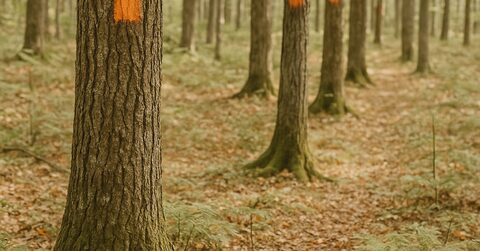
Marked boundary trees on a woodlot line

What working with us is like

From the first call to a filed plan

A real first conversation

The first call is unhurried. We want to understand what you own, what changed recently, and what you are trying to figure out - whether that is enrollment, a plan renewal, a timber question, or just getting a clearer picture of what you have. You will not be rushed toward a proposal.

Walking the ground together

The site visit is where the work actually happens. We walk the land, read the stand, and talk through what management could look like over the coming decade. By the end of the walk you have a forester's honest read on your land - what is there, what it can do, and what it cannot - before any document is written.

A plan written in plain language

We write the management plan to meet Vermont Department of Forests, Parks and Recreation standards for Use Value Appraisal enrollment, and in language you can actually use when you are standing in the woods a few years from now making a decision. The document is yours; it should be readable without a forestry degree.

Staying current between renewals

We keep a calendar of every plan we have filed. When your ten-year renewal is approaching, we reach out - you should not have to track the annual application deadline administered by the Department of Taxes on your own. Questions between plan cycles get answered without commissioning a new document.

Most landowners contact us because something changed: they bought a parcel, inherited enrolled land, or realized their ten-year plan is about to expire. The first conversation is usually a phone call with no agenda other than understanding what you have and what you are trying to figure out. We ask more questions than we answer at that stage, because the right plan for a family that wants to keep the land intact for grandchildren looks nothing like the right plan for someone who wants a sustainable timber income. From there we schedule a walk. That is where the real work starts. We read the stand, take notes on what is growing and where, and talk through what management could look like over the coming decade. After the walk you will know roughly what a plan would recommend before we write a word of it. Writing and filing the plan is the deliverable most people think of first, but it is really the last step in a longer conversation. The document we produce is formatted to meet Vermont Department of Forests, Parks and Recreation standards for Use Value Appraisal enrollment, and it is written in plain language so you can actually use it as a reference when you are standing in the woods making decisions years from now. We keep a calendar of when plans come up for renewal and reach out before deadlines arrive, so the annual application deadline administered by the Department of Taxes does not catch anyone off guard.

Whether you are a new landowner trying to understand what enrollment in Vermont's Use Value Appraisal program even means, a longtime Current Use participant whose plan needs updating, or a family working through whether the program makes sense for your land at all - this practice is set up for that kind of work. Browse our services to see what we offer, visit pricing for a straightforward look at how fees are structured, and check the FAQ if you have questions about the process. The state program office is the authority on eligibility rules, deadlines, and any land use change tax that might apply; we will always point you there for those answers rather than paraphrase the statute.

Our territory

The ground we know

Windham County covers a lot of ground, from the open ridge lines above Marlboro and Halifax to the wetter, hemlock-heavy drainages along the West River and the Saxtons River corridors. The soils, the deer pressure, the logging access, and the mix of working farms and reverting old fields all vary by town. Local knowledge - which roads wash out in April, which mills are actually buying, which town clerks process deed research quickly - is not something you can read in a textbook. It shapes the advice. See our service areas for the towns we cover regularly.

Windham County woodlots have their own character. A lot of the forested land here is old farmland that has been coming back since the mid-twentieth century, and you can read that history in the stand structure: stone walls running through second-growth sugar maple and yellow birch, apple trees half-swallowed by the canopy edge, pasture white pine that is now mature enough to be worth something. Mixed hardwood and softwood stands dominate, but the mix shifts considerably with elevation and aspect. Steep terrain is common, and it limits both equipment access and the range of practical silvicultural options. Mud season is not a figure of speech; it closes roads and determines when logging work can responsibly happen. These are conditions that shape management recommendations in ways that a generic plan cannot account for.

Areas we serve

Honest scoping

Work we do not take on, and who does it better

We are a consulting forestry practice. That scope is deliberate, and being clear about it is part of giving honest advice. We do not buy timber, and we do not broker timber sales on commission. Some foresters mark a stand and then earn a percentage of the stumpage revenue when it sells. That structure creates an incentive to mark more volume than is silviculturally appropriate, to push a harvest before the stand is ready, or to steer the sale toward a buyer who pays the forester rather than the one who serves the landowner best. We are paid by the landowner for professional time, which is a different arrangement and a different set of loyalties. We do not do logging or land clearing. If a harvest is recommended in your management plan, we can help you think through what to look for in a logger and what a sound timber sale contract should include, but the contracting relationship is yours. We will refer you to loggers whose work we have seen and respect. We do not do surveying. Boundary questions come up on almost every parcel, and when they do we refer landowners to licensed land surveyors. Getting the boundary right before a harvest or an enrollment application matters, and that work belongs with someone who carries the right license and liability. We do not do real estate. If you are trying to decide whether to buy a particular parcel, we can walk it with you and give you a forester's read on what is there - but for valuation in a transaction, you want a licensed appraiser with timberland experience. We do not cover every corner of Vermont. Our work is concentrated in Windham County and the towns immediately around it. If your land is well outside that range, we would rather refer you to a competent forester who knows your local conditions than do a worse job for you from a distance. Knowing what you do not do is not a limitation. It is how you stay useful to the people who hire you.

The standard we hold ourselves to is the one that applies when nobody is checking. A state reviewer will look at whether a management plan is formatted correctly and whether the required elements are present. They will not walk your land to see whether the stand descriptions match what is actually growing there. That gap between what is verifiable and what is true is where professional standards either hold or they do not. In practice this means a few things. When we describe a forest stand in a plan, the description comes from measurements and field notes taken on that stand, on that visit, not from an adjacent stand that looked similar or from the previous plan that nobody updated. When we recommend a silvicultural treatment, we can explain why that treatment fits the age, structure, and composition of what is there, and why the alternatives are less appropriate. When we do not know something, we say so. It means we do not file a management plan before we are confident it reflects the land. Vermont's Use Value Appraisal program requires a plan that meets Department of Forests, Parks and Recreation standards, and meeting those standards on paper while missing the point in the field is not something we are willing to do. It means we keep our own calendar of renewal deadlines for every parcel we have filed a plan on. The annual application deadline administered by the Department of Taxes is a real date with real consequences, and the responsibility for flagging it should not fall entirely on the landowner. It means we return calls and answer questions between plan cycles, because a landowner who wants to know whether a proposed skid road conflicts with their management plan should be able to get a straight answer without commissioning a new document. None of this is unusual in a well-run professional practice. We mention it because it is worth knowing what you are hiring for.

Your forester should work for you, not the buyer

In the timber industry, the same person sometimes marks the trees to cut, arranges the sale, and earns a share of the revenue. That arrangement is not illegal, and many foresters who operate that way are honest professionals. But the structure carries a built-in pressure that is worth understanding before you hire anyone. When the forester's income depends on the volume harvested, the incentives point in one direction: toward more cutting, sooner, at a price the forester has a hand in negotiating. A stand that would benefit from another decade of growth is harder to recommend leaving alone when you earn nothing for recommending patience. A buyer who pays referral fees to foresters is easier to favor than one who does not. This shows up in marked stands in ways a landowner may not notice. Residual stocking left too thin to maintain canopy closure. Trees marked that were not yet at the diameter or quality that would make the harvest worthwhile for the landowner. A contract written to protect the buyer's access and schedule without the same care for the landowner's timber and soil. A consulting forester paid directly by the landowner has a different set of loyalties. The advice is worth giving honestly because the relationship is with the person who owns the land, and only with that person. The plan reflects what you want the land to do over time, with the tax treatment as a consequence of good land management rather than as the thing driving every decision.

We charge for professional time. The fee structure is straightforward: you pay for the work, we give you our honest read on what the land needs and what it does not need, and there is no transaction on the other end of the advice that we benefit from. That is the whole arrangement. Before hiring any forester, it is worth asking a few direct questions: Are you paid on commission from timber sales? Do you have a financial relationship with any of the loggers or buyers you might recommend? Who do you represent in a timber sale negotiation? The answers will tell you whose side the advice is on. For a full picture of how our fees are structured, visit fees. For questions about Vermont's Use Value Appraisal program - who qualifies, what the enrollment deadline is, and what the land use change tax means for your situation - the Vermont Department of Forests, Parks and Recreation and the Department of Taxes are the right places to go. We will always point you there rather than give you our paraphrase of the statute.

If that sounds like the way you want this handled, tell us what you are dealing with and we will give you a straight answer about what it takes.

Talk to a forester

Tell us about the land

Town, rough acreage, and whether the parcel is already enrolled. If you are working to a filing deadline, say which one and we will tell you honestly whether it is achievable.

Give us a phone or email and we reply the same day, usually. No obligation.

Rather talk it through?Leave a name and number and someone who has walked a lot of Windham County woodlots calls you back.