
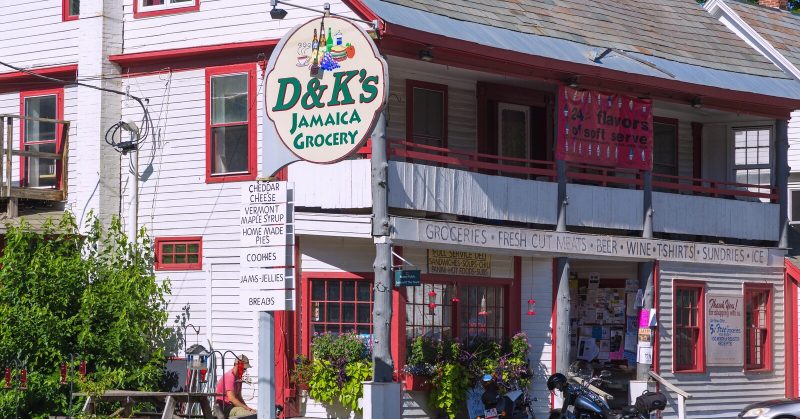
Our consulting forestry practice serves Jamaica, Vermont landowners with professional forest management plans, timber stand assessments, woodland health evaluations, and enrollment guidance for Vermont's Current Use (Use Value Appraisal) program. We work directly with private landowners across Jamaica's varied terrain - from steep West River valley slopes to the upland ridges bordering the Green Mountain National Forest - covering everything from initial site visits through plan writing and annual compliance.
Jamaica, Vermont: A Town Shaped by Forest and Slope
Jamaica is a small hill town in the upper Windham County region of southern Vermont, defined almost entirely by its relationship to the land. The West River cuts through the valley floor, and from there the terrain rises sharply in almost every direction. Most of Jamaica's privately held land is forested - the flat, open acreage that dominates southern Vermont's more agricultural towns is largely absent here. Instead, landowners deal with mixed hardwood and softwood forests on steep to very steep slopes, rocky soils, and a range of elevations that produce meaningfully different growing conditions within a single parcel. That topographic variety is not incidental to forestry work here; it defines every management decision, from timber harvesting feasibility to species composition targets to how a logging operation can be responsibly designed.
The town's population is small and largely year-round, supplemented by a notable number of second-home and vacation property owners who have purchased land in or near Jamaica over the decades. The presence of Jamaica State Park and the adjacency of the Green Mountain National Forest give the landscape a decidedly wild character, and many private landowners chose their properties precisely for that quality. This means that purely extractive approaches to forest management rarely fit what Jamaica landowners are looking for. What tends to work here is a long-horizon perspective - managing for forest health, wildlife habitat, and sustainable timber value simultaneously, rather than prioritizing any one of those goals at the expense of the others. If you are curious about the full range of what a professional consulting forester can do, our services page outlines every aspect of the work we provide.
Climate, Terrain, and the Conditions That Drive Forest Management Needs
Jamaica's climate is firmly northern temperate, with cold winters, a compressed but genuine mud season, and summers that are warm but rarely extreme. Snowpack is significant most years, and the town sits at elevations where ice storms and late-spring frosts are facts of life rather than exceptions. Those conditions bear directly on forest health. Sugar maple, yellow birch, beech, and red spruce are all common species here, and each responds differently to the stress cycles that Jamaica's climate produces. The ongoing pressure of beech bark disease is real and visible in many Jamaica woodlots. Ash stands are dealing with the advancing front of emerald ash borer. These are not abstract regional trends - they show up on individual parcels and change the calculus of any honest management plan.
The steep terrain amplifies many of these concerns. On slopes, soil compaction from poorly planned logging is a serious and long-lasting problem. Erosion risk is genuine when skid trails or landings are placed without care for drainage patterns and natural water flow. Any time timber harvesting is being considered on Jamaica land, the site-specific conditions - slope aspect, soil type, proximity to the West River or its tributary streams, and existing stand structure - all need to be factored into the plan before any equipment moves. Vermont's silvicultural regulations exist for good reason, and in a topographically complex town like Jamaica, following them rigorously is not just a legal matter but a practical one.
What Jamaica Landowners Typically Call About
The most common reason Jamaica landowners reach out is to understand what is happening in their woods and what their options are. Many have owned property for years - some for generations - and notice changes in the forest they cannot quite categorize: a lot of dead ash, a thinning of beech, sections of forest that were logged before their ownership and have not regenerated as expected. Others have received unsolicited contact from logging operations and want an independent professional assessment before making any decisions. Both are completely reasonable starting points, and they are exactly what a consulting forester is for.
Current Use enrollment is the other major reason for contact. Vermont's Use Value Appraisal program substantially reduces property taxes on enrolled forestland, but it requires an approved forest management plan written by a licensed professional forester, updated on a regular schedule, and implemented in good faith. For landowners in Jamaica who are sitting on significant acreage - and many are - this program can represent a meaningful annual tax reduction. The management plan itself is a real working document, not a form letter. It describes the property, its soils and species composition, its management history, and a set of specific activities to be carried out over the plan period. Our frequently asked questions page addresses many of the common questions landowners have about the Current Use program and what the plan process involves.
Estate and succession planning is a third driver. When land passes between generations, or when a landowner is beginning to think about how their property will be handled long-term, having a current and well-documented forest management plan in place provides a foundation. It establishes what the land is, what has been done on it, and what a future steward should know - a gift to whoever comes next, whether that is a family member or a conservation organization.
How This Work Is Done Well in Jamaica
Good forestry work in Jamaica starts with a site visit and an honest conversation. There is no substitute for walking the land. Aerial photography and GIS mapping are useful tools, but a forester who has not walked the property cannot responsibly characterize the stand structure, identify the problem areas, or make sound management recommendations. Jamaica's terrain rewards careful ground work - the slopes and hollows and wet seeps that define these parcels are what determine both the opportunities and the constraints.
Vermont's licensing requirements for foresters and the state's timber harvesting guidelines provide the regulatory framework, and any professional working here should be thoroughly familiar with both. For parcels that share boundaries with Jamaica State Park or the Green Mountain National Forest, there may be coordination considerations or boundary matters worth addressing in advance. Road access to Jamaica parcels can also be a logistical factor - some properties are reached by seasonal roads or private right-of-ways, and any plan that involves active timber harvesting needs to account for when and how heavy equipment can realistically access the site without causing lasting damage to access roads or adjacent land.
What the Process Looks Like, Start to Finish
A landowner in Jamaica who reaches out for a free consultation can expect the following general sequence. First, a preliminary conversation about the property - its size, ownership history, any known management history, and what the landowner's goals are. Then, a site visit, which is the core of the work. The forester walks the property, takes measurements, identifies species and stand conditions, notes any problem areas, and begins to form the management recommendations that will become the written plan.
After the site visit, the written forest management plan is prepared. For Current Use purposes, this plan must meet Vermont's statutory standards, and it is submitted to the appropriate state office as part of the enrollment or re-enrollment process. Once the plan is approved, the landowner has a schedule of management activities to follow over the plan period. The consulting forester remains available for questions, for guidance when activities specified in the plan are ready to be carried out, and for the plan update that will eventually be required. This is not a one-time transaction but an ongoing professional relationship. Landowners who want to understand how this fits within the broader landscape of land stewardship options in the region can browse the areas we serve to see how we work across Windham County.
Common Mistakes to Avoid
The most consequential mistake Jamaica landowners make is responding to unsolicited timber buying offers without first getting an independent appraisal and professional guidance. The value of timber on a Jamaica parcel depends entirely on species, grade, volume, and market conditions at the time of sale - none of which an unlicensed buyer has an interest in representing accurately to the seller. A consulting forester working for the landowner has no stake in the timber sale itself and can advise objectively on what the resource is worth and what, if anything, should be harvested.
A second common mistake involves Current Use: waiting too long to get a plan in place. Enrollment is not retroactive, and the tax savings begin only from the point of approved enrollment forward. Landowners who have been eligible for years and simply have not gotten around to it have already left money on the table. Starting the process sooner rather than later is simply in the landowner's interest.
Finally, treating a forest management plan as a checkbox exercise rather than a working document tends to produce poor results. The plan is most valuable when it reflects genuine knowledge of the property and real management intentions. A plan written from a desk without a site visit, or copied from a template with minimal customization, does not serve the landowner well - and under Vermont's Current Use requirements, substantive compliance is expected.
Why Jamaica Landowners Work With a Professional Consulting Forester
Jamaica is not an easy place to own forested land casually. The terrain is demanding, the ecological pressures are real, and the regulatory environment - from Current Use requirements to logging rules to water quality protections - requires working knowledge to navigate competently. Landowners who try to go it alone, or who rely on advice from parties with a financial interest in the outcome, routinely end up with poorer results than they would have achieved with qualified professional help. A consulting forester represents the landowner's interests exclusively, bringing technical knowledge, regulatory familiarity, and the kind of site-specific judgment that only comes from experience working on similar properties in similar conditions across the region.
Nearby Communities and Regional Context
Jamaica shares borders and landscape character with several other Windham County towns worth noting for landowners who hold property across town lines or who are exploring options across the region. Townshend, Londonderry, Winhall, and Stratton all present similar forestry conditions - steep terrain, mixed species forests, and active interest in Current Use enrollment. The areas we serve page covers our full regional footprint across Windham County and neighboring communities. Wherever your land is, the goal is the same: a professionally managed, well-documented, and appropriately enrolled forest that works for you over the long term.
FAQ
Questions about Jamaica
- My Jamaica property is mostly steep slope with some wet areas near a stream - can it still qualify for Current Use enrollment?
- Yes, in fact those conditions are common on Jamaica parcels and do not disqualify land from Current Use enrollment. Vermont's Use Value Appraisal program applies to forestland regardless of slope or the presence of wetland or riparian areas - those features simply get reflected in the forest management plan. The plan will account for buffers along stream corridors and identify where active management is appropriate versus where the land should be left undisturbed.
- How often does a Current Use forest management plan need to be updated for a Jamaica property?
- Vermont requires that an approved forest management plan be updated on a schedule set within the plan itself, typically every ten years, though plans often call for shorter review intervals when significant changes are anticipated. For Jamaica properties with active pest pressures - beech bark disease, emerald ash borer - a plan update may be warranted sooner if those conditions materially change the stand composition or the management recommendations that were originally written.
- A logging company contacted me about buying timber on my Jamaica land. What should I do before agreeing to anything?
- Before responding to any unsolicited timber buying offer, get an independent assessment from a consulting forester who works for you, not for the buyer. Jamaica's forested slopes carry timber value that can be significantly understated by a buyer with a commercial interest. A consulting forester will evaluate species, volume, and grade, advise you on current market conditions, and help you structure any sale in a way that protects both the value of the timber and the long-term health of the forest.
- What does a site visit for a forest management plan actually involve on a Jamaica property?
- The forester walks the property with you, taking measurements of tree diameter and height across representative sample areas, identifying species composition, noting regeneration patterns, flagging problem areas such as diseased trees or poorly drained sections, and observing any prior logging evidence or infrastructure. On Jamaica's terrain, the site visit also includes assessing slope conditions, skid trail feasibility, and proximity to water resources - all of which shape the management recommendations in the written plan.
- I inherited a Jamaica property that was logged about fifteen years ago. Is it too early to think about a new management plan?
- Fifteen years post-harvest is actually a good time to assess regeneration and plan the next phase of management. Stands logged at that interval in Jamaica's climate are typically in an active regeneration stage, with competition among species determining what the future forest will look like. A consulting forester can evaluate which species are establishing well, identify any areas where regeneration has failed, and recommend interventions - such as crop tree release or invasive species control - that will shape the stand for decades to come.
- Does having land adjacent to Jamaica State Park or the Green Mountain National Forest affect my management plan or Current Use enrollment?
- Proximity to public land does not disqualify your parcel or change the basic structure of your Current Use plan. It may, however, raise boundary and coordination considerations worth addressing - particularly if you are planning any active harvesting near the shared boundary. In terms of ecology, adjacency to large conserved blocks often means your land has higher wildlife corridor value, which a well-written management plan can acknowledge and incorporate into habitat-oriented management objectives.
Talk to a forester
Tell us about the land
Town, rough acreage, and whether the parcel is already enrolled. If you are working to a filing deadline, say which one and we will tell you honestly whether it is achievable.