
Timber harvesting in Vermont: choose a licensed forester and protect your land
Hire the wrong person to oversee a timber harvest on your Windham County woodlot and you may not notice the damage for five years, but you will be living with it for fifty. Choosing a licensed consulting forester before the chainsaws arrive is one of the most consequential decisions a Vermont landowner ever makes, and it deserves a careful, unhurried look.
This post walks through why the licensing distinction matters, what a forester actually does during a harvest, the red flags to watch for when interviewing candidates, and the practical steps to protect your land's long-term health whether your property sits in Newfane, Grafton, Marlboro, or anywhere else in our region.
Why "forester" and "logger" are not the same title
Loggers and foresters both have essential roles in a timber harvest, but they are not interchangeable. A logger is the operator, the crew and equipment that physically fell, skid, and haul trees. A consulting forester is the professional who assesses your woods, marks the trees to be cut, writes the prescription for how the harvest should happen, and then monitors the job from start to finish.
In Vermont, foresters who offer consulting services for a fee must be licensed by the state under Vermont Statutes Title 26, Chapter 84. The Vermont Department of Forests, Parks and Recreation (VDFPR) maintains the licensing registry, and you can verify any forester's credentials directly through the state. This is not a formality. The licensing exam and continuing education requirements exist because forestry involves real technical judgment: reading stand structure, calculating sustainable harvest volumes, protecting water quality, and complying with Vermont's Acceptable Management Practices (AMPs) for logging.
A logger, however skilled, is typically compensated by the volume of wood removed. That is not a criticism; it is simply a different incentive structure. A consulting forester who charges you a fee for professional services has a direct obligation to your goals, not to maximizing board feet hauled out of the woods.
What Vermont's Acceptable Management Practices actually require
Vermont's AMPs, published and enforced by the VDFPR, set the minimum standards for any logging operation in the state. They cover stream and wetland buffers, skid trail design, slash management, and seasonal restrictions meant to protect soils and water quality. Per the VDFPR's AMP guidance, loggers operating in Vermont are required to follow these practices on every job, but compliance is far more reliable when a licensed forester is on site to enforce the prescription.
The AMPs are not optional suggestions. Violations can result in stop-work orders, required remediation, and fines. More practically, a harvest that ignores buffer requirements or compacts soils on wet ground can impair a stream, kill future regeneration, and trigger erosion that reshapes your hillside. In a hilly landscape like Windham County, where many woodlots drain into the West River, the Saxtons River, or smaller tributary brooks, that is not a hypothetical risk.
If you want to understand how a formal management plan fits into all of this, our post on what a Vermont Current Use forest management plan must include goes deeper on the written-plan side of the equation.
The concrete steps to finding and hiring a licensed forester
1. Start with the state registry. The Vermont Department of Forests, Parks and Recreation publishes a list of licensed consulting foresters. Cross-check any name you receive from a neighbor or logger against that list before you go further.
2. Look for relevant regional experience. Vermont's forests vary enormously across elevation and soil type. The sugar maple and beech stands on the slopes above Newfane and Townshend behave differently from the mixed softwood and northern hardwood stands found in Jamaica and Wardsboro. Ask candidates how many acres they have worked in your specific part of Windham County and what the dominant species and issues were on those jobs.
3. Ask about their fee structure up front. Consulting foresters typically charge in one of three ways: a flat project fee, an hourly rate, or a percentage of timber sale revenue. Each has trade-offs. A percentage-of-sale fee can align the forester's incentive with maximizing sale value, which is fine if that is your goal, but discuss it openly. If your primary goal is long-term stand improvement rather than maximum immediate revenue, say so clearly and ask how that changes their approach.
4. Request references from recent harvests. Call those landowners. Ask whether the forester visited the site during logging (not just before and after), whether the slash and skid trails were cleaned up as agreed, and whether they felt their questions were answered honestly throughout the project.
5. Walk your property together before signing anything. A good forester will want to spend time in the woods before giving you any numbers. They should be pointing out regeneration, noting any invasive species issues, discussing the age and health of your dominant trees, and asking about your goals. If someone is eager to skip the field work and get to the contract, that is a meaningful warning sign.
What a forester actually does during the harvest itself
Marking trees is only the beginning. A licensed forester overseeing a harvest in your Grafton or Athens woodlot should be doing all of the following:
- Pre-harvest layout: Flagging skid trails and log landings to minimize soil disturbance and keep equipment out of buffer zones.
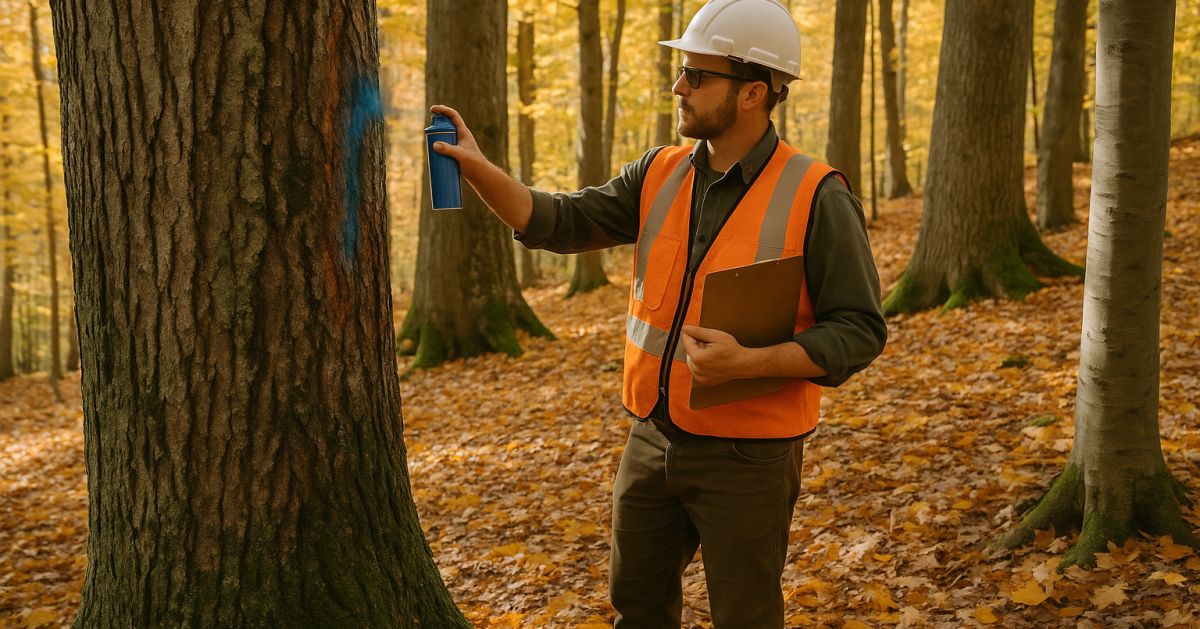
- Tree marking: Using paint to identify precisely which trees are to be cut and which are leave trees, often including crop trees that represent the future of your stand.
- Timber sale administration: If there is a competitive bid process (which is the right approach for any harvest of meaningful scale), the forester writes the prospectus, receives bids, and helps you evaluate them. They also prepare the timber sale contract, which should include performance bonds, insurance requirements, and restoration obligations.
- Job monitoring: Visiting the site regularly during active logging to ensure the prescription is being followed, the AMPs are met, and any problems are caught early before they become permanent.
- Post-harvest inspection: Walking the entire harvested area after the crew leaves to document compliance and identify any remediation needed before the logger is paid in full.
If a forester is not willing to commit to site visits during the harvest itself, that is a gap worth questioning directly.
Common mistakes landowners make before the first tree falls
A mistake that comes up again and again in landowner forums is signing a timber deed without independent legal and forestry review. A timber deed transfers the right to cut trees on your property to a buyer for a defined period. Without a licensed forester reviewing what is being conveyed and a lawyer reviewing the legal terms, you may discover the deed permits far more cutting than you expected or that it runs for longer than you realized.
Another problem reported by owners in our region is agreeing to a harvest without a written contract that specifies the leave-tree standards, the buffer widths, the deadline for removing slash from stream crossings, and the remediation bond. Handshake agreements are not enforceable in a way that protects your land.
A third issue is timing. Soils on Vermont's slopes are highly vulnerable during mud season and immediately after heavy rainfall. A harvest that starts in late March and tears up your access road and skid trails can create erosion channels that take years to stabilize. Your forester should include seasonal restrictions in the timber sale contract.
Current Use enrollment and how a harvest fits in
If your woodland is enrolled in Vermont's Current Use program, or if you are considering enrollment, timber harvesting is not just permitted, it is expected as part of a sound forest management plan. Vermont's Use Value Appraisal program (Current Use) requires that enrolled forestland follow an approved management plan, and harvesting at appropriate intervals is often a core prescription in those plans.
What you cannot do is harvest outside the bounds of that plan without risking a penalty or withdrawal from the program. This is another reason to have a licensed forester involved: they write plans that are approvable by the state and then design harvests that conform to those plans. Our guide on how to enroll your Windham County woodland in Vermont's Current Use program covers the enrollment steps in detail.
If you are already in the program and your plan is coming up for renewal, or if a harvest is on the horizon, our consulting forestry and forest management plan services are designed specifically for landowners in this situation.
Special considerations for Windham County terrain
Windham County's topography creates some harvesting challenges that do not show up in a flat-country forestry textbook. Many woodlots in towns like Halifax, Marlboro, and Windham are steep, with thin soils over bedrock and small, cold headwater streams that feed into larger drainages. Those headwater streams are some of the most ecologically sensitive features on the landscape, and Vermont's AMPs set specific buffer requirements around them.
Wetlands are another local variable. Southern Vermont's hillside forests often transition into seeps and vernal pools that are not obvious in summer but become critical habitat in spring. A forester who knows Windham County terrain knows where to look for these features before designing a skid trail network.
Ice storms and wind events have also left many local stands with structural damage in the upper canopy. A forester can distinguish between salvage-worthy dead and dying wood and leave trees that look rough but are still ecologically valuable as wildlife habitat.
Questions to ask any forester you are considering
- Are you currently licensed in Vermont? (Verify this independently.)
- How many timber sales have you administered in Windham County in the last five years?
- Do you carry professional liability insurance?
- What is your process if a logger deviates from the prescription mid-job?
- How do you handle the post-harvest remediation process?
- Are you familiar with the AMPs for logging, and have you ever had a job cited for a violation?
That last question is worth asking directly. A forester who has never had a close call may simply not have done much work. A forester who has had a citation should be able to explain clearly what happened and what changed in their process afterward.
Where to go from here
If your woodlot is in Newfane, Townshend, Jamaica, Grafton, or any of the other towns we serve across the region, the first conversation is usually the most valuable one. You can see the full list of towns we cover on our locations page, and our frequently asked questions address a number of the issues landowners raise before they pick up the phone.
When you are ready to talk through your specific property and goals, the contact page is the easiest place to start. There is no obligation in that first conversation, and understanding your woods before committing to any harvest is exactly the kind of thinking that keeps Windham County forests healthy for the long run.
Talk to a forester
Tell us about the land
Town, rough acreage, and whether the parcel is already enrolled. If you are working to a filing deadline, say which one and we will tell you honestly whether it is achievable.