
Landowner liability, logging contracts, and forester roles in Vermont timber sales
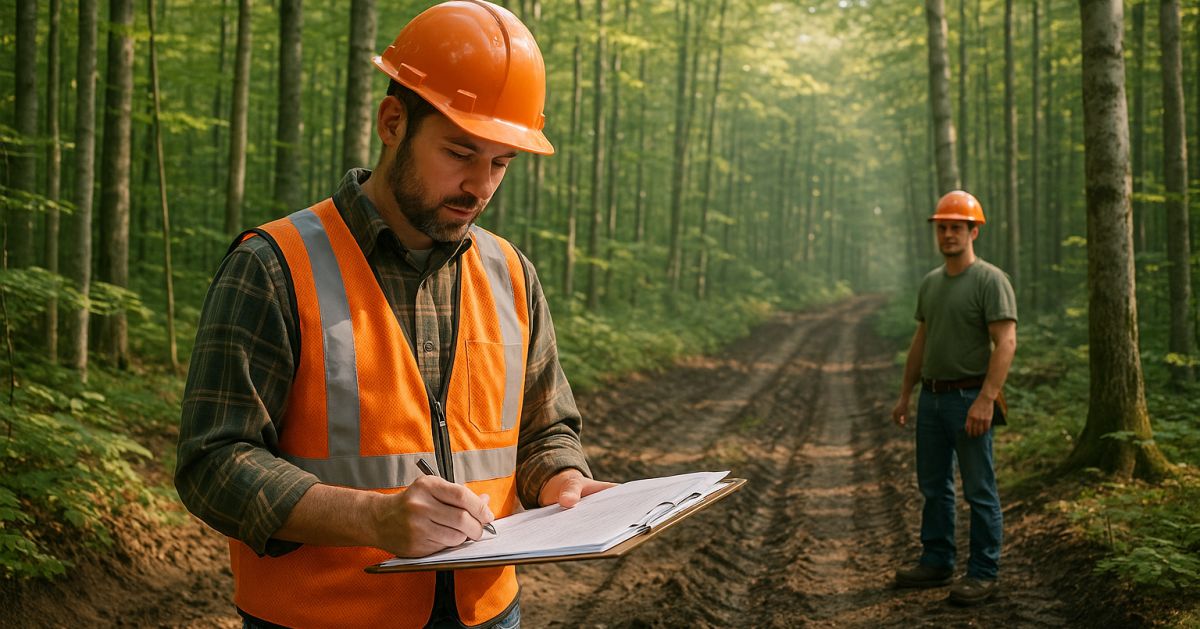
Signing a timber sale agreement without understanding what you are agreeing to is one of the fastest ways to lose money, damage your land, and expose yourself to legal claims you never saw coming. Vermont's forestry laws and common-law liability rules create a web of responsibilities that touch every timber harvest, from a small woodlot in Athens to a larger working forest in Halifax. This post walks through the three pillars of a safe, profitable timber sale: landowner liability, a solid logging contract, and the forester's role in keeping everything on track.
Why landowner liability matters before the first cut
Many woodland owners assume that once they hand over harvesting rights to a logger, responsibility for what happens on the property shifts entirely to that logger. Vermont law does not work that way, and misreading this point can be costly.
As a landowner, you have a legal duty of care toward workers and, in some circumstances, toward the public. Vermont's logging operations are subject to the Vermont Agency of Natural Resources' (ANR) Required Acceptable Management Practices (AMPs) for Forestry. These are not voluntary guidelines. They are the legally required minimum standards for any timber harvest in the state, and a landowner who knowingly allows a harvest to proceed in violation of them can share in the legal exposure.
Beyond the AMPs, consider these specific liability scenarios that come up in Vermont timber sales:
- Worker injury on your land. If a logging crew member is injured and the logging company lacks adequate workers' compensation coverage, you could face a claim. Vermont requires loggers to carry workers' compensation, but verification is the landowner's job before work begins.
- Damage to neighboring property. A tree or log that crosses a property line, a skid trail that redirects stormwater onto a neighbor's field, or a culvert failure on a shared road can all generate neighbor disputes and civil claims.
- Water quality violations. Vermont takes its clean water rules seriously. Harvest operations that allow sediment to reach a stream, wetland, or road ditch can trigger enforcement action by ANR. The landowner of record is a named party in those proceedings.
- Third-party access. Vermont has a long tradition of permissive recreation on private forestland. Snowmobilers, hikers, and hunters often cross private timber lots. If a harvest leaves hazardous conditions (unstable slash piles near a trail, unmarked open culverts), liability questions follow.
The best protection against all of these scenarios is a forester-supervised harvest governed by a well-written contract. Those two things work together; neither alone is sufficient.
What a logging contract must actually contain
A handshake deal, or a one-page letter of intent, leaves too much ambiguous. A logging contract for a Vermont timber sale should be a working document that answers every practical question before the chainsaw starts. Here is what experienced foresters recommend including.
Parties and property description
Name the landowner, the logging contractor, and (if applicable) a third-party timber buyer. Attach or incorporate a legal description of the parcel and a map showing the harvest unit boundaries. Ambiguity about where harvesting is permitted leads to over-cutting on adjacent parcels, a problem that is expensive and embarrassing to fix after the fact.
Species, volumes, and marking
Specify which trees may be cut. In a well-managed sale, marked trees are identified by a forester before the contract is signed. The contract should state that only marked trees (or marked areas in a clearcut unit) may be felled. This single clause, when enforced by a consulting forester on the ground, prevents high-grading, the practice of taking the best trees and leaving the rest, which degrades long-term forest value. Our page on consulting forestry and current use forest management plans explains why pre-harvest marking is central to good forest stewardship.
Payment terms and timber cruise data
State the price per thousand board feet (MBF) or per cord for each species, or reference a lump-sum payment tied to a pre-sale timber cruise. Include when payments are due (often at delivery to the mill), how scaling will be done, and who has the right to audit mill tickets. Landowners in Grafton and Townshend who have sold timber without a cruise often report receiving far less than neighboring properties that had a professional volume estimate in hand before negotiating.
Harvest period and completion deadline
Set a start date, a completion date, and conditions under which harvesting must pause (mud season, wet soil conditions). Vermont's AMP guidelines recommend suspending skidder operations when soils are saturated, because ruts and compaction on wet ground cause lasting damage to soil structure and water quality. The contract should give the forester authority to issue a work stoppage for weather or soil conditions without that being considered a breach.
Road and skid trail standards
Specify where equipment may travel, the width of skid trails, culvert sizing requirements, and who is responsible for road maintenance during and after the harvest. Include a clause requiring the logger to install and maintain water bars and other erosion controls on skid trails per Vermont ANR's AMP standards. Require that all temporary roads be properly closed and seeded at completion.
Insurance and indemnification
Require the logger to provide certificates of insurance before work begins, including:
- General liability (minimum limits should be specified)
- Workers' compensation as required by Vermont law
- Commercial auto coverage for log trucks
Include an indemnification clause that holds the landowner harmless from logger negligence, but have a Vermont attorney review this language. Indemnification clauses that are too broad can be unenforceable, and ones that are too narrow leave gaps.
Damage provisions and bond
Specify what constitutes unauthorized cutting (trees outside the marked area, trees below minimum diameter, trees in a riparian buffer), and state a per-tree penalty. A performance bond or deposit held in escrow until the logger completes all site restoration work is a strong incentive for proper cleanup. This clause is particularly important for larger sales where the financial stakes are high.
Dispute resolution
Include a clause naming Vermont as the governing jurisdiction and specifying whether disputes go to mediation, arbitration, or court. Many foresters recommend a first-step mediation requirement because it resolves most disagreements faster and cheaper than litigation.
The forester's role: much more than marking trees
A consulting forester is not simply someone who walks your woodlot and puts paint on trees. In a Vermont timber sale, the forester is the technical expert, the project manager, and the landowner's primary advocate throughout the process.
Pre-harvest: inventory and planning
Before any contract is written, a forester conducts a timber inventory (cruise) to estimate the volume and value of merchantable timber. This data gives the landowner negotiating power. Without it, you are accepting the logger's or buyer's estimate of what your trees are worth, which is a significant information disadvantage.
The forester also reviews the property for sensitive features: vernal pools, steep slopes, riparian buffers along streams, rare plant communities, and existing trails. These features need to be mapped and protected in the harvest plan. For landowners enrolled in Vermont's Current Use program, the harvest must align with the approved forest management plan. You can read more about what those plans require in our post on what a Vermont Current Use forest management plan must include.
Marketing the timber
A consulting forester working on your behalf will solicit competitive bids from multiple licensed loggers and buyers. This is where landowners who try to manage a sale on their own often leave the most money on the table. Timber markets in Windham County can vary significantly by species, log quality, and mill demand. Having a forester present sealed bids, review them, and advise you on the offer is a straightforward way to improve your return.
During the harvest: oversight and quality control
Active oversight during the harvest is what separates a forester-supervised sale from a self-directed one. Your forester should make regular site visits (frequency depends on the scale of the operation), verify that only marked trees are being felled, check that erosion controls are in place after rain events, and communicate with the logger about any concerns before they become problems.
If you are enrolled in the Current Use program, active oversight also protects your enrollment. An improperly conducted harvest that violates your management plan can trigger a review by the Vermont Department of Forests, Parks and Recreation. That is a headache worth avoiding. Our frequently asked questions page addresses how harvesting affects Current Use enrollment in more detail.
Post-harvest: site assessment and reporting
When the logger leaves, the forester walks the entire harvest unit to document completion of all contract requirements: water bars installed, skid trails seeded, culverts cleaned, landing area restored. Any deficiencies are documented in writing and communicated to the logger before the final payment or bond release.
For Current Use landowners, the forester may also update the management plan to reflect the harvest and schedule the next silvicultural activity, whether that is a pre-commercial thinning in a young stand, an improvement cut in ten years, or simply monitoring for natural regeneration.
A note on forester qualifications in Vermont
Vermont does not require consulting foresters to hold a state license in the same way some professions do, but professional credentials matter. Look for a forester who is a Certified Forester (CF) through the Society of American Foresters or a Licensed Consulting Forester in states that use that designation. Ask for references from landowners in your area, specifically Windham County if that is where your land is.
For Current Use enrollees, Vermont law requires that a licensed forester prepare and certify the forest management plan. The Vermont Department of Forests, Parks and Recreation maintains a list of licensed foresters. Working with someone who already knows the local mills, loggers, and terrain in towns like Newfane, Marlboro, Jamaica, or Wardsboro is a practical advantage.
If you are just beginning to think about what managing your woodland looks like, our services page describes how we help landowners through the consulting forestry and management plan process from start to finish.
Common mistakes that come up in Vermont timber sales
A few patterns come up again and again when landowners reflect on timber sales that did not go as planned:
- Accepting the first offer. Without competitive bidding, there is no way to know if the offered price is fair. A forester-managed bid process almost always produces better results.
- Skipping the contract review. Contracts drafted by logging companies naturally favor the logger. Have a forester and ideally an attorney review any contract before signing.
- Not verifying insurance. Certificates of insurance should be current. Call the insurance company to confirm the policy is active, not just inspect the paper certificate.
- Assuming the logger knows the boundaries. Boundary disputes after a harvest are more common than landowners expect. A forester paints boundary lines before the harvest begins.
- Ignoring the post-harvest period. Site restoration takes time and follow-through. Holding a portion of payment or a bond until restoration is complete is the most effective way to ensure it happens.
Putting it all together for your Windham County woodlot
Whether your land is in Townshend, Newfane, or Windham, the same framework applies: understand your liability before work starts, protect yourself with a thorough contract, and engage a qualified forester to represent your interests from inventory through site restoration.
Vermont's timber market rewards landowners who are prepared. Good timber that is well-marketed, harvested under a solid contract, and properly documented holds its value in the landscape and produces returns you can measure. If you are thinking about a timber sale or want to know how your woodland fits into the Current Use program, the locations page is a good place to start, or reach out directly through our contact page to talk through your situation.
A timber sale done right protects your land, your neighbors, your legal standing, and your long-term income from the forest. The paperwork and the planning are not obstacles to getting there; they are how you get there.
Talk to a forester
Tell us about the land
Town, rough acreage, and whether the parcel is already enrolled. If you are working to a filing deadline, say which one and we will tell you honestly whether it is achievable.